Side Projects · 2026
Parallel Competition Production — Five Entries Through One Pipeline
Five idea competitions closed on the same date, July 31, 2026. I pushed all five through one line of my proposal-automation harness and submitted four. The fifth missed the online submission cutoff and was never submitted.
Outcome5 completed · 4 submitted · 1 not submitted (online submission window closed)
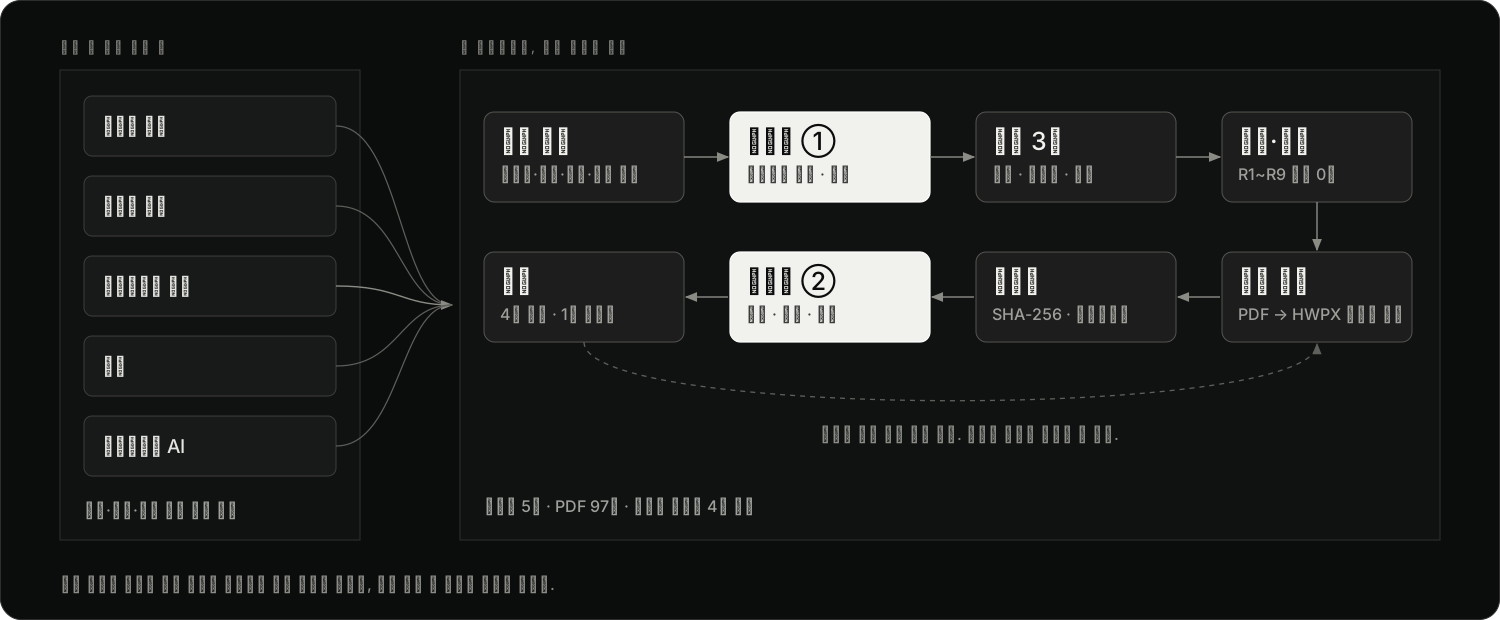
Five deadlines on one day
At the end of July, the deadlines all landed on one date: Malitda Gyeonggi (「말잇다 경기」) for the Gyeonggi Virtual Convergence Content Challenge, The Medal’s Homecoming (「훈장의 귀향」) for the Veterans Affairs Public Data & AI Idea Competition, ChemiSafe Twin (「케미세이프 트윈」) for the Ulsan Digital Twin Idea Competition, Salpi (「살피」) for the Nuclear Safety Information Sharing Portal AI Character Competition, and MixSafe AI (「믹스세이프 AI」) for the Laboratory Safety AI Idea Competition. The topics, templates, and submission methods were all different. Three went by email attachment, one through an online form, and one needed an HWP (Hancom Office document format) file and a ZIP of images attached separately.
To submit five entries in the same window, writing, typesetting, and moving content into the official templates had to repeat as one procedure. So I put the work on top of my proposal harness. I fixed the points where a person decides at two, and had agents repeat the same procedure in between.
The order the harness runs in
- Call analysis — Pulls the deliverables, scoring criteria, deadline, and file rules out of the call for proposals and uses them as constraints for every later step. Anything the call does not state is left as
[확인 필요](needs confirmation) instead of being guessed. - Gate 1, idea selection — Candidates come in and a person picks one. I picked Malitda Gyeonggi on Jul 16.
- Three contracts — A text contract (one consolidated draft in noun-ending bullet style), an image contract (a plan for diagrams and scenario images), and a layout contract (the manifest). The build runs only when all three are in place.
- Build and automated checks — Embeds the images in a single HTML file and outputs an A4 PDF. Checks R1–R9 look at style, number sourcing, placeholders, and unfinished figures. A draft passes only with zero violations.
- Template transfer — Inserts the pages of the finished PDF as-is into the official HWPX, leaving only the personal-information and signature fields as editable boxes. I save it in Hancom Office, export it to PDF again, and compare it with the original pixel by pixel. That is how Veterans Affairs matched 37/37, Laboratory Safety 11/11, and Ulsan 13/13.
- Packaging — SHA-256 hashes for every file, a pre-submission checklist, a draft of the sending email, and a table of the final attachments, all in one folder.
- Gate 2, the human finish — A person fills in personal information, signs by hand, scans, and sends. I recorded “files complete” and “submission done” as separate states:
ready_finalandsubmitted.
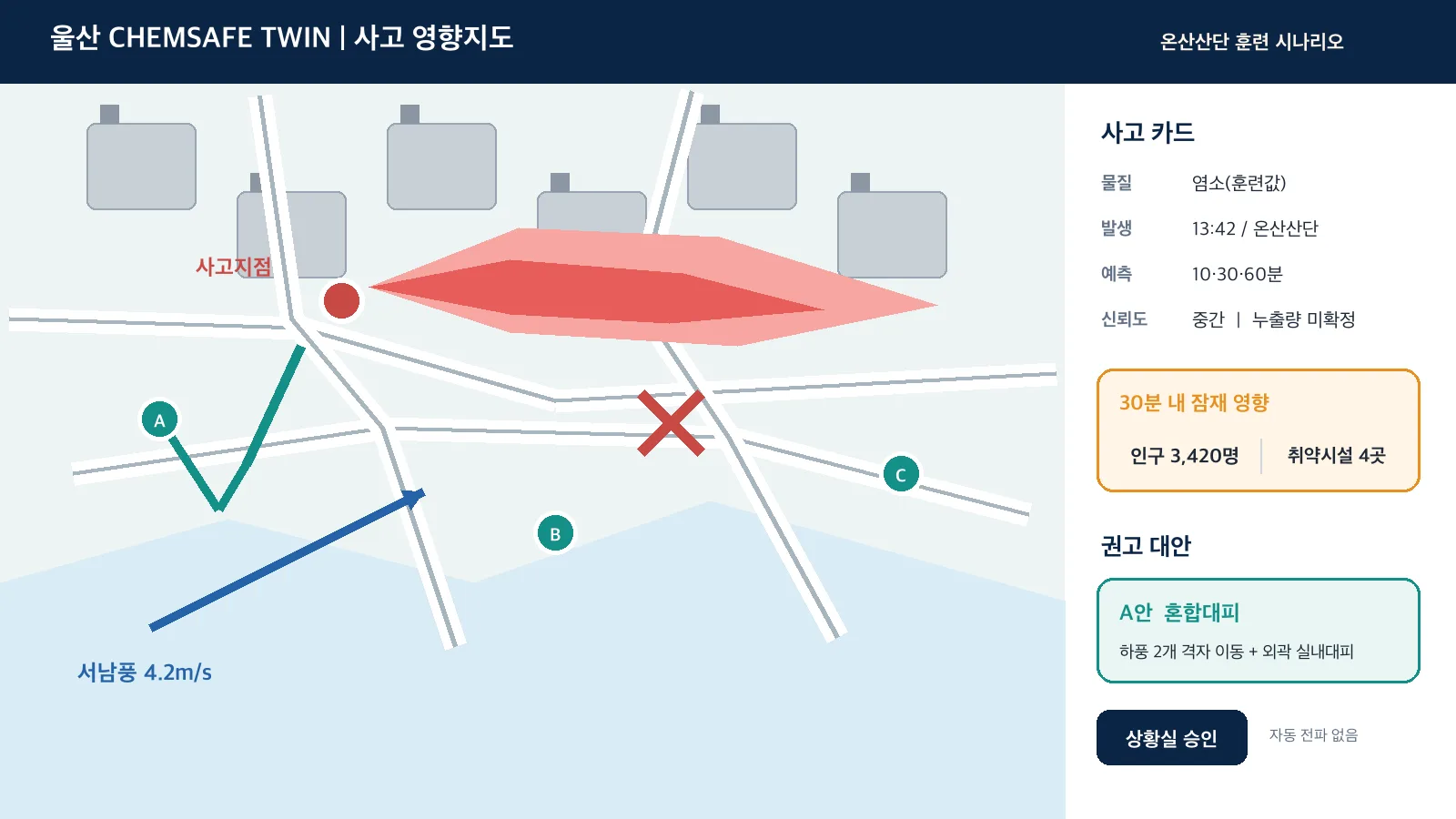 A draft of the incident impact map for “ChemiSafe Twin,” one of the five. The diagrams and screens in the proposals were made with code and generative models according to the image contract, then embedded in the body at the typesetting step.
What each of the five produced
- Malitda Gyeonggi — A 19-page HWP and PDF combining 4 pages of official forms, a 9-page proposal, and a 6-page wireframe appendix. It plans a service for foreign-born parents to rehearse school admission consultations.
- The Medal’s Homecoming — A 37-page PDF combining a 5-page plan and 32 pages of supporting material: data analysis, screens, and prompts. It plans a platform that uses record linkage to find the descendants of people whose decorations were never delivered.
- ChemiSafe Twin — A digital twin for evacuation decisions during chemical accidents in industrial complexes. A ZIP bundling signed copies of three forms and a 13-page proposal PDF.
- Salpi — An AI character for the nuclear safety portal. The structure was an application HWP plus a separately attached image ZIP containing basic and applied PNGs and a design sheet.
- MixSafe AI — A system that warns about incompatible chemicals before an experiment. Completed through an 11-page HWP and PDF.
Malitda Gyeonggi has its own card on this site.
The last three days
On Jul 29, the Ulsan entry reached the ready-to-submit stage, and on Jul 30 and 31 I pushed the rest through in the same order. In the final review I revised the text of all five against the same style standard, and in each one I enlarged a single scenario image to half the body width. On the night of the deadline I reorganized the master files into one folder and kept a log of what moved.
What I dropped · Where it fell off
- Laboratory Safety, not submitted — The online form closed at 18:00. The files were complete, but the deadline passed without a submission-confirmed screen. I kept the finished assets for a reissued call or a similar competition.
- Dropped the direct-HWP path — For the Ulsan entry I tried writing the proposal directly in HWP and converting DOCX to HWP, then stopped. After that, every entry used the same path: “build a PDF and insert it into the HWPX as pages.”
- Master-copy confusion — An older PDF with the same name as the final was still in the parent folder, the prep folder had been duplicated in Finder so the PDFs inside differed, and the final Ulsan ZIP was scattered across three places. I recorded only the moves in a cleanup log and narrowed it to one master set.
- Proof of submission — Four entries are recorded as
ready_finalbased on the files. Whether submission actually completed has to be checked outside these records.
What this line produces is a procedure. Feed in one call for proposals, and it comes out the same way through template transfer and review, with the places a person has to touch reduced to two.