Systems · 2026
Personal AI Operations Harness
A personal work system that ties playbooks, agent specs, approval gates, a cost watchdog, and weekly reviews into md contract files, so Claude, Codex, and Gemini run in parallel under the same rules.
OutcomeRunning since 2026-07-04 — 4 executable harnesses and 3 rounds of weekly review so far; the Threads cost incident settled the watchdog rules
Three AIs reading the same files
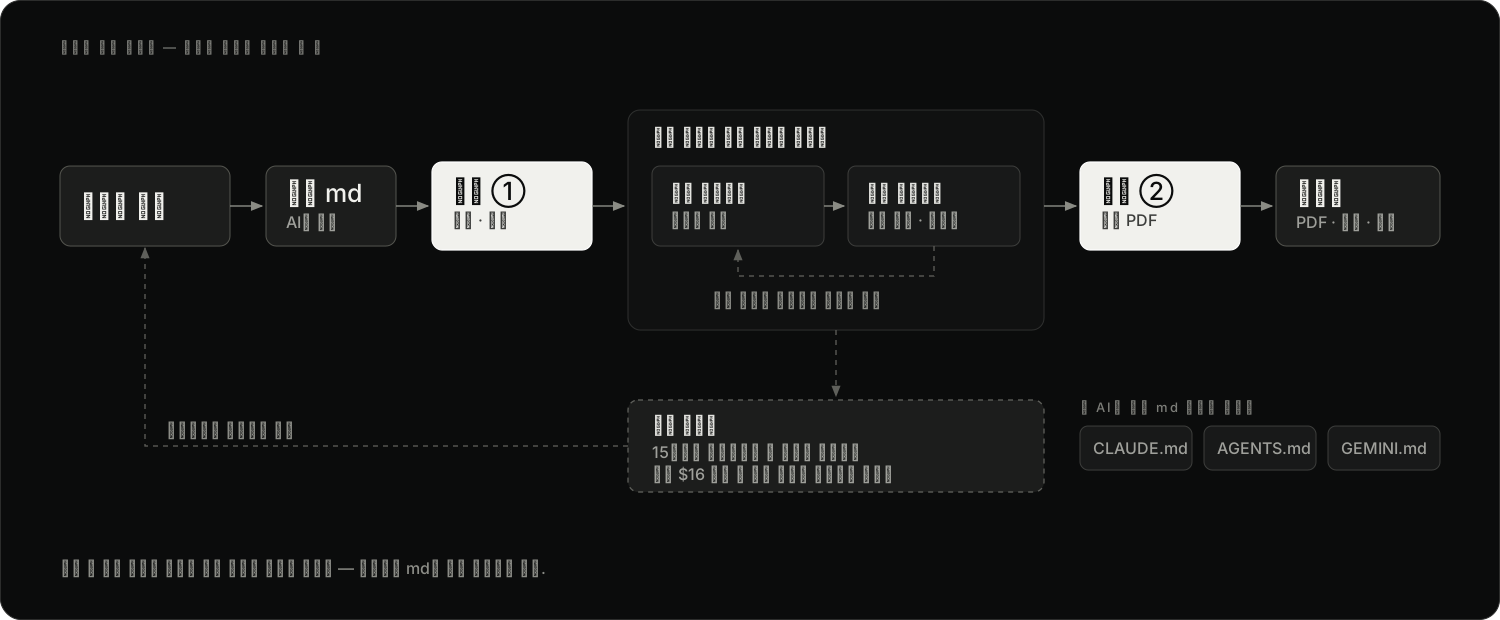
I use Claude Code, Codex CLI, and Gemini CLI together in one workspace. The instructions are md files with no syntax specific to any one AI; only the entry point is renamed as CLAUDE.md, AGENTS.md, or GEMINI.md. Whichever session I open, it follows the same procedure. Outputs are isolated in claude_work/ and codex_work/, and originals and submitted versions are kept read-only. A higher-tier model handles judgment and design, and execution is delegated. A plan is written as an md file, and execution starts only after a person approves it.
Structure
- Identity and rules — Profile, operating principles, context capsule, command guide, and an overall map. I wrote the capsule so it reads on its own even when pasted as-is into an outside AI.
- 6 playbooks — One procedure document per line of work. Content, lectures, weekly review, competition kickoff, and proposal decks belong here.
- Agent specs, 3 tiers and 9 roles — A chief of staff who routes requests, 5 specialists, and 3 supervisors (reviewer, recorder, scheduler). The reviewer has read-only permissions and only issues verdicts.
- 4 executable harnesses — 901 proposal automation (call for proposals → typeset PDF, S0–S5), the competition studio (P0–P6), MD→HWP writing, and Remotion video production.
- Weekly review and dashboard — Scans the past 7 days of changes, updates the status board, raises alerts 14 days before deadlines, and tallies [확인 필요] (needs confirmation) items in one report.
Automation with gates
A person approves only at the two points where direction is set, and the rest runs automatically. In 901 those two points are the concept and outline, and the typeset PDF; in the competition studio they are idea selection and storyboard sign-off. Starting the next step before passing a gate is forbidden.
The session that writes a draft and the session that reviews it are also kept separate. In the same context, you cannot see your own errors. The reviewer is read-only and only issues verdicts, and rejects the work if there is even one critical issue.
Cost watchdog
On the day I attached cost tracking and a watchdog to the Threads automation pipeline, daily spending measured $16. The $60 monthly limit had already been used up to $57.78 in 11 days. I stopped the entire pipeline that day.
Since then, every API automation gets a budget cap and a watchdog by default. The watchdog checks the heartbeat and daily cost every 15 minutes and sends alerts on Telegram.
What I dropped · Where it got stuck
- Threads automation — Fully stopped on 2026-07-12 because cost exceeded results.
- Style bank contamination — A style guide meant for proposals was wrongly adopted as the source for presentation decks, and the first real deck had to be thrown out. I banned cross-referencing styles between domains.
- The bottleneck is decisions — In a full check on 07-12, nearly every track had stalled after its output was finished, waiting on my decision. The next task is making decisions cheap.